
 Call: +91 9266610101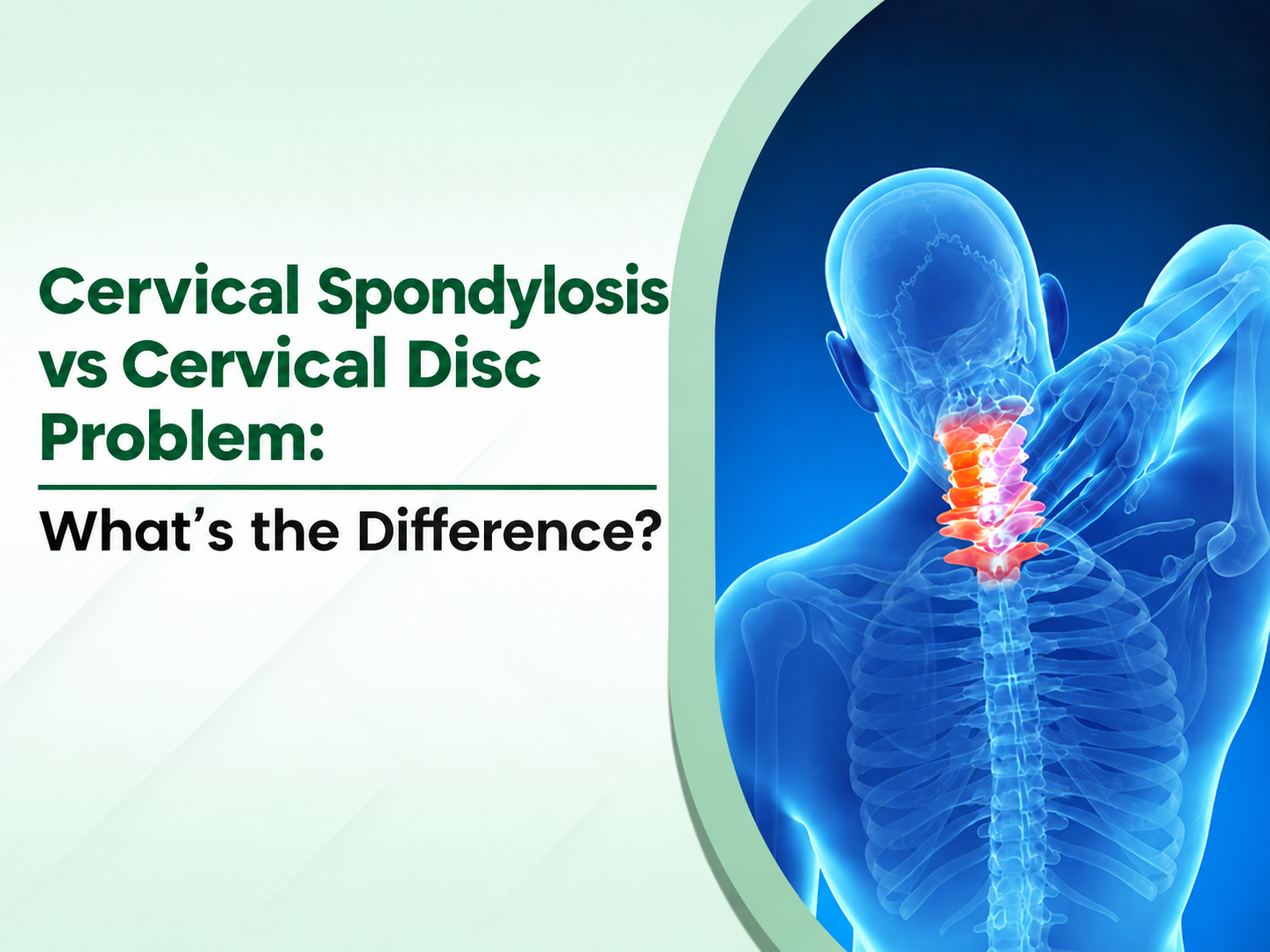
Cervical Spondylosis vs Cervical Disc Problem: What’s the Difference?
Neck pain, stiffness, and pain that travels into the shoulder or arm can have several possible causes. Cervical spondylosis and cervical disc problems are two common conditions affecting the neck, and their symptoms can sometimes overlap. While cervical spondylosis is mainly associated with age-related changes in the bones, joints, and discs of the cervical spine, a cervical disc problem may involve a bulging, protruding, or herniated disc that can sometimes irritate nearby nerves.
Understanding the differences between these conditions can help you seek appropriate evaluation and treatment. Consulting specialists at the Best Orthopedic Hospital in Noida can support accurate diagnosis and personalised management of neck and spine conditions.
Understanding Cervical Spondylosis Causes
Cervical spondylosis refers to age-related wear and degenerative changes affecting the discs, vertebrae, and joints in the neck. These changes are common with increasing age and may not always cause symptoms. When symptoms develop, they can include neck pain, stiffness, reduced movement, or, in some cases, nerve-related symptoms.
Factors associated with cervical spondylosis include:
- Age-Related Disc Changes: Spinal discs can gradually lose water content and become thinner, reducing their flexibility and shock-absorbing capacity.
- Bone Spurs: Bony growths called osteophytes may develop around the vertebrae as part of the degenerative process.
- Changes in Spinal Joints: The facet joints in the cervical spine may develop degenerative changes that contribute to pain and stiffness.
- Ligament Changes: Ligaments around the cervical spine may become thicker or less flexible over time.
- Previous Neck Injury: Earlier trauma or repeated strain may contribute to degenerative changes in some individuals.
Cervical spondylosis does not always require treatment. Management depends on symptoms, clinical findings, and whether nerves or the spinal cord are affected.
Identifying Cervical Disc Problems
A cervical disc problem occurs when one of the discs between the neck vertebrae develops structural changes. A disc may bulge, protrude, or herniate, and in some cases the altered disc can irritate or compress a nearby nerve root.
Common features of cervical disc problems include:
- Bulging or Herniated Disc: The outer portion of a disc may weaken or develop a tear, allowing the inner material to move outward.
- Nerve Root Irritation: A disc herniation may irritate or compress a cervical nerve root, causing pain, tingling, numbness, or weakness in the shoulder, arm, or hand.
- Neck and Arm Pain: Some people experience neck pain together with radiating pain into the arm, although symptoms vary according to the affected nerve.
- Pain With Certain Movements: Symptoms may worsen with particular neck movements or activities, depending on the underlying condition.
- Sudden or Gradual Onset: Disc-related symptoms can develop suddenly or gradually and are not necessarily caused by a single lifting or twisting event.
Importantly, a disc bulge or herniation seen on an imaging scan does not always cause symptoms. Clinical examination is needed to determine whether the imaging finding is relevant to the patient's symptoms.
Cervical Spondylosis vs Cervical Disc Problem: Key Differences
Although both conditions can affect the cervical spine, there is considerable overlap between them. Cervical disc degeneration can itself be part of the broader degenerative changes seen in cervical spondylosis.
Some general differences include:
- Underlying Changes: Cervical spondylosis involves degenerative changes affecting multiple structures of the cervical spine, while a cervical disc problem specifically involves an abnormality of a spinal disc.
- Pain Pattern: Spondylosis may cause local neck pain and stiffness, whereas a disc herniation affecting a nerve may cause radiating pain into the shoulder, arm, or hand.
- Numbness and Tingling: Nerve irritation or compression from a disc problem can cause numbness or tingling in a particular part of the arm or hand. Similar nerve symptoms can also occur with cervical spondylosis when bone spurs or other degenerative changes narrow the space around a nerve.
- Weakness: Significant nerve compression from either condition can cause muscle weakness. Persistent or progressive weakness requires medical evaluation.
- Spinal Cord Involvement: Advanced cervical spondylosis or a disc problem can sometimes contribute to spinal cord compression, potentially causing problems with balance, walking, hand coordination, or other neurological functions.
Because symptoms can overlap, the distinction cannot always be made based on symptoms alone. A specialist may recommend neurological examination and imaging such as X-rays or MRI depending on the clinical findings.
Exploring Modern Treatment Options
Treatment depends on the cause and severity of symptoms, whether nerves or the spinal cord are affected, and the patient's overall health. Many people can initially be managed without surgery.
Treatment options may include:
- Physical Therapy: Targeted exercises can help improve neck mobility, strength, posture, and functional movement.
- Pain-Relief Medicines: Non-steroidal anti-inflammatory drugs or other medicines may be recommended when clinically appropriate.
- Posture and Ergonomic Guidance: Adjusting workstation setup and daily activities may help reduce unnecessary strain on the neck.
- Epidural Steroid Injections: Image-guided injections may be considered for selected patients with cervical nerve root pain when conservative treatment has not provided sufficient relief.
- Minimally Invasive Spine Surgery: Procedures such as cervical discectomy and fusion or other decompression procedures may be considered when there is significant nerve or spinal cord compression, progressive neurological symptoms, or persistent symptoms despite appropriate non-surgical treatment.
Consulting specialists at the Best Orthopedic Hospital in Delhi can provide access to appropriate diagnostic evaluation, spine care, rehabilitation, and surgical treatment when clinically indicated.
At Yashoda Medicity, treatment plans are developed according to the patient's symptoms, examination findings, imaging results, and overall health.
Preventing Future Neck Problems
Not all age-related spinal changes can be prevented, but healthy habits may help support neck function and reduce avoidable strain.
Useful measures include:
- Maintaining an Ergonomic Posture: Keep computer screens at a comfortable height and avoid prolonged positions that cause neck strain.
- Taking Regular Movement Breaks: If you work at a desk for long periods, change position and move your neck and shoulders regularly.
- Performing Appropriate Exercises: Gentle strengthening and mobility exercises can support neck function when recommended by a healthcare professional or physiotherapist.
- Using a Comfortable Sleeping Position: Choose a pillow that supports a neutral and comfortable neck position.
- Staying Physically Active: Regular activities such as walking and other suitable exercises can support overall musculoskeletal health.
- Avoiding Unnecessary Strain: Use appropriate lifting techniques and avoid activities that repeatedly aggravate your neck symptoms.
If neck pain is persistent, recurrent, or associated with numbness, weakness, balance problems, or pain radiating into the arm, a specialist evaluation can help identify the underlying cause.
Conclusion
Cervical spondylosis and cervical disc problems are related but not identical conditions, and they can occur together. Symptoms alone may not be enough to distinguish between them. A clinical examination and, when appropriate, imaging such as an MRI can help determine whether degenerative changes, disc herniation, nerve compression, or spinal cord involvement is contributing to the symptoms.
At Yashoda Medicity, spine specialists provide individualised evaluation and treatment for cervical spine conditions, with non-surgical management, rehabilitation, pain interventions, and surgery available when clinically indicated.
If you have persistent neck pain, stiffness, radiating arm pain, numbness, or weakness, schedule a consultation for an appropriate cervical spine evaluation.
FAQs
1. What is the key difference between cervical spondylosis and a cervical disc problem?
Cervical spondylosis refers to age-related degenerative changes involving structures such as the discs, vertebrae, and facet joints of the neck. A cervical disc problem specifically involves an abnormality such as a bulging, protruding, or herniated disc. The two conditions can occur together.
2. How do the symptoms of cervical spondylosis and disc problems differ?
Cervical spondylosis may cause neck pain, stiffness, and reduced movement. A cervical disc problem can cause similar symptoms and may also cause radiating arm pain, numbness, tingling, or weakness when a nerve is irritated or compressed. Symptoms can overlap, so specialist evaluation may be required.
3. What non-surgical treatments are available at Yashoda Medicity?
Depending on the diagnosis, treatment may include physical therapy, appropriate pain-relief medicines, ergonomic guidance, therapeutic exercises, and image-guided epidural steroid injections for selected patients.
4. What lifestyle practices can support neck health?
Maintaining an ergonomic workstation, taking regular movement breaks, staying physically active, performing appropriate neck exercises, and avoiding activities that aggravate symptoms can support cervical spine health.
5. When should I consult a spine specialist for neck pain?
You should consider specialist evaluation if neck pain persists or keeps returning, particularly when it is accompanied by radiating arm pain, numbness, tingling, weakness, difficulty walking, balance problems, or reduced hand coordination. Progressive weakness or significant neurological symptoms require prompt medical assessment.