Open Emergency Modal

Frequently Asked Questions

Robotic-Assisted Urological Surgery at Yashoda Medicity uses the sophisticated da Vinci Xi surgical system to perform complex operations with extraordinary precision. In contrast to conventional techniques, this system offers surgeons a 3D, high-definition, 10x-magnified view of the surgical area, along with "wristed" instruments that replicate the human hand while providing a broader range of motion and eliminating hand tremor. This aspect is extremely important when performing even more challenging operations, such as radical prostatectomies or partial nephrectomies, where it is crucial to have utmost preservation of the nerves and blood vessels that are extremely fragile. From a patient's perspective, this means much less blood loss, few or no scars, and a much more rapid resumption of usual activities.

Dr. Vaibhav Saxena leads the surgical treatment of a diverse range of urological cancers at Yashoda Medicity, focusing on attention to every detail. He has extensive working experience in Prostate Cancer (Robotic Radical Prostatectomy), Kidney Cancer (Robotic Partial or Radical Nephrectomy), and Bladder Cancer (Robotic Radical Cystectomy with urinary diversion). Besides this, he also treats complicated tumors of the adrenal gland, the ureters, and the testicles. By merging robotic technology with cancer surgery expertise, Dr. Saxena can not only perform extensive tumor removal but also preserve the organ's function, which is further enhanced by the hospital's advanced multidisciplinary oncology board, which provides comprehensive cancer care.

Single Keyhole Surgery, also known as advanced minimally invasive laparoscopy, is one of the main features of Dr. Saxena's work at Yashoda Medicity. The method uses one small incision (usually less than 2-3 cm) through which the abdomen is accessed. This radically lowers the "surgical trauma" related to operations. The chief advantages are that the patient experiences little pain after the operation, has a reduced risk of wound infection, and achieves the best cosmetic effect with almost invisible scars. These patients, who have had significant operations such as pyeloplasty or nephrectomy by this method, generally have fewer painkillers and stay in the hospital only for 24 to 48 hours, sometimes, thus managing a fast recovery compared to open surgery.

Reconstructive Urology aims to restore normal urinary tract function after injury or surgery, or in cases of inherited defects. It is the specialty of Dr. Vaibhav Saxena at Yashoda Medicity, who mainly treats Urethral Strictures (scarring that narrows the urethra) and applies leading Urethroplasty techniques. To treat a normal case, doctors typically use buccal mucosa (mouth tissue) grafts, but advanced or recurrent strictures require specialized methods. Dr. Saxena performs top-notch microsurgical suturing and tissue transfer procedures to secure a wide, patent urinary passage, with which patients are significantly less likely to suffer a recurrence than those who follow traditional "dilatation" or "stretching" methods.

Dr. Vaibhav Saxena is the first to propose using Fascia Lata (the tough connective tissue obtained from the thigh) for urethral reconstruction when grafts are unavailable or fail. This essentially provides a strong, biologically active, and well-vascularized matrix that can be literally 'woven' to the urinary tract. At Yashoda Medicity, the technique has achieved tremendous long-term success rates in complex, multi-stage reconstructions. It is also a highly effective and long-lasting option for patients suffering from severe urethral damage, and it leads to greater urination and the benefit of improved patients' lives by a wide margin.

Robot-Assisted Pyeloplasty is offered at Yashoda Medicity to kids having UPJ Obstruction (the blockage at the junction of the kidney and ureter). Generally, if the blockage is causing pain, recurrent infections, or loss of kidney function, then one has to undergo the above-mentioned treatment. Robotic surgery is the perfect fit for the delicate, miniature anatomical features of a child. It can give an ultra-precise sewing of the small ureter, ensuring a tightly sealed operation. Yashoda, parents also like this because it leads to far smaller "keyhole" scars, less trauma for the child, and a drastically reduced hospital stay (usually just 2 days).

At Yashoda Medicity, the renal transplant program is a detailed, multidisciplinary initiative overseen by Dr. Vaibhav Saxena. It starts with detailed immunological cross-matching and pre-transplant "prehabilitation". In the operation, the hospital's modular OTs provide a completely sterile environment for the donor and recipient. Post-surgery care is provided in a separate Transplant ICU, with a focus on real-time Doppler ultrasound of the graft, accurate titration of immunosuppressants, and daily creatinine monitoring. This intensive monitoring, together with expert nursing care, facilitates early recognition of rejection and supports the long-term health of the transplanted kidney.

When it comes to the treatment of Benign Prostatic Hyperplasia (BPH), Yashoda Medicity is equipped with 100 -Watt Holmium Laser technology (HoLEP), the latest in laser technology. This bloodless high-precision laser surgery enables Dr. Saxena to "enucleate" or physically extract the prostate tissue causing obstruction. Laser surgery, in contrast to traditional TURP, is not only effective for large prostates but also safe for elderly patients on blood thinners. Thanks to the laser's precision, the nerves around the prostate are intact, and side effects like incontinence or sexual dysfunction are very unlikely. The majority of patients experience relief of their urinary symptoms immediately, and catheter removal is typically performed within 24 hours.

If you see blood coming out of your urine, especially if it is without pain, seek consultation at Yashoda Medicity immediately. This can be an early sign of bladder or kidney cancer. Besides, if you have chronic pelvic pain, urinary urgency, or a weak urinary stream, do not hesitate to see a doctor. Early intervention by Dr. Vaibhav Saxena enables the use of non-invasive diagnostics, such as high-resolution ultrasound or flexible cystoscopy. Diagnosing ailments like stones, infections, or early tumors early considerably improves the success of minimally invasive therapies and stops long-term kidney damage.

Dr. Vaibhav Saxena's joining the UK (BAUS) and Australian international fellowships has greatly shaped his "Evidence-Based" and "Patient-Centric" surgical ideology at Yashoda Medicity. These worldwide experiences have enabled him to integrate Western standards of surgical safety, standardized clinical pathways, and the latest minimally invasive innovations into his work. He follows a "nerve-sparing" and "tissue-preserving" technique, which is well recognized internationally in urology. This global outlook ensures that residents of Ghaziabad receive the same standards of healthcare, surgical precision, and post-operative recovery as those in the world's top medical centers.

Endourology at Yashoda Medicity offers a "scarless" solution, even for the most complex Staghorn Calculi (large stones that completely fill the kidney). By employing techniques such as PCNL (Percutaneous Nephrolithotomy) or RIRS (Retrograde Intrarenal Surgery), Dr. Saxena can remove stones using the natural urinary tract or through a very small incision. The stones are then "dusted" into the tiniest particles by high-performance lasers. Such a procedure is a far cry from the large, painful cuts required in the old method of open stone surgery. Besides preserving maximum kidney function, it allows patients with heavy stone burdens to return to work quickly after only a few days.

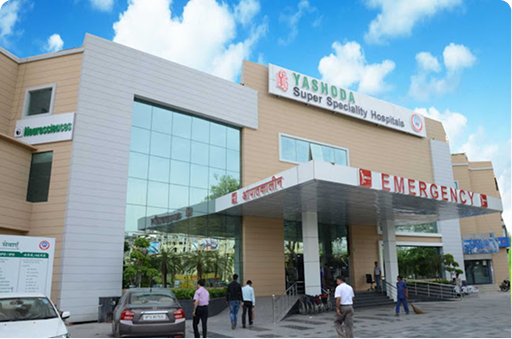
Yashoda Medicity, Indirapuram (Ghaziabad), is the leading center for 24/7 emergency robotic urological care and renal services in the Delhi NCR area. In addition to a well-equipped trauma emergency unit, the hospital also offers round-the-clock access to expert urologists, including Dr. Vaibhav Saxena. In case of an acute kidney stone crisis, sudden urinary retention, or emergency transplant-related complications, the hospital's advanced facilities and "Code Blue" protocols ensure an instant response. Patients can avail of state-of-the-art robotic technology and access life-saving urological care at any time, under one roof.