
 Call: +91 9266610101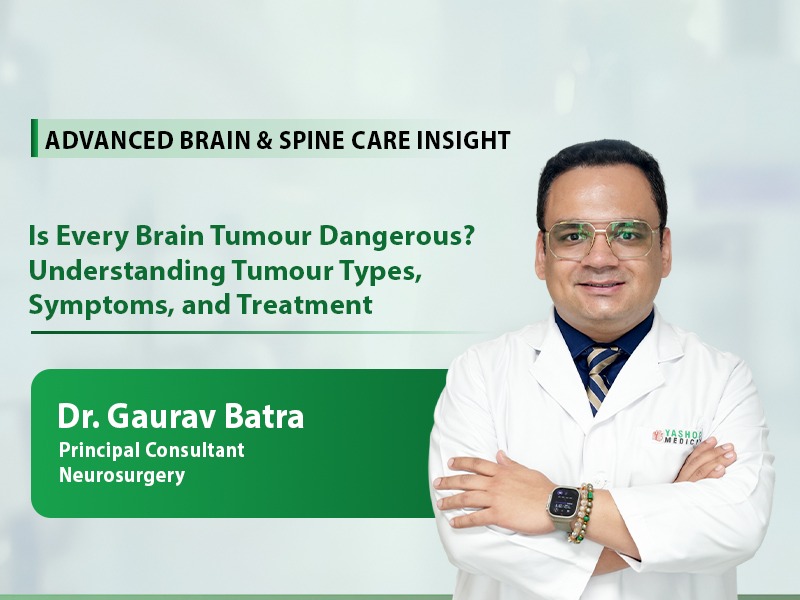
Is Every Brain Tumour Dangerous? Understanding Tumour Types, Symptoms, and Treatment
Discovering an abnormal mass within the skull can trigger immediate fear, leading many to assume that all brain tumours are inherently fatal. However, brain tumours vary significantly in their origin, tissue characteristics, biological behaviour, location, and overall health impact. Consulting an experienced neurosurgeon in Delhi NCR can help individuals understand the nature of the condition and make informed decisions about diagnosis and treatment.
Understanding Intracranial Lesion Types
Not all intracranial masses pose the same level of risk. Their impact depends on factors such as cellular makeup, growth rate, size, and anatomical location. Brain lesions may originate within the brain or spread from another part of the body.
Primary brain tumours originate within the brain, central nervous system tissues, or surrounding structures, whereas secondary or metastatic brain tumours occur when cancer cells from another part of the body spread to the brain.
- Benign Intracranial Tumours: These are non-cancerous growths that generally do not spread to other parts of the body. However, depending on their size and location, they can still cause significant symptoms and may require treatment.
- Malignant Brain Tumours: These are cancerous tumours that may grow and spread into surrounding brain tissue, often requiring specialised treatment.
- Primary Brain Tumours: These tumours originate within the brain, cranial nerves, or surrounding protective structures.
- Secondary or Metastatic Brain Tumours: These occur when cancer from another part of the body, such as the lungs or breasts, spreads to the brain.
Recognizing Common Warning Symptoms
Recognizing potential warning signs can help individuals seek timely medical evaluation. Symptoms may develop when a tumour affects specific areas of the brain or increases pressure within the skull.
Common neurological symptoms may include:
- Persistent or Worsening Headaches: Headaches that become progressively more frequent or severe, particularly when accompanied by other neurological symptoms.
- New-Onset Seizures: Seizures occurring without a previous history may require neurological evaluation.
- Progressive Weakness or Numbness: Weakness, numbness, or reduced coordination affecting the face, arm, or leg.
- Cognitive or Behavioural Changes: Changes in memory, concentration, personality, speech, or vision.
- Balance or Coordination Problems: Difficulty walking, maintaining balance, or performing routine movements.
These symptoms can also occur due to conditions other than brain tumours. A medical evaluation is important for identifying the underlying cause.
Comparing Benign vs Malignant Brain Tumours
Understanding the differences between benign and malignant Brain, Spine Tumour & Minimally Invasive Neurosurgery Specialist can help clarify treatment approaches and prognosis. However, each tumour behaves differently, and factors such as location, size, grade, and overall health must also be considered.
- Growth Pattern: Benign tumours often grow slowly, while malignant tumours may grow more aggressively. However, growth patterns can vary between tumour types.
- Cellular Characteristics: Benign tumours contain non-cancerous cells, whereas malignant tumours contain cancerous cells that may invade surrounding brain tissue.
- Impact on Brain Function: Both benign and malignant tumours can affect important brain structures depending on their location and size.
- Recurrence Risk: The likelihood of recurrence varies depending on tumour type, grade, location, and the extent of treatment.
- Treatment Goals: Treatment may focus on maximum safe tumour removal, controlling tumour growth, preserving neurological function, and improving quality of life.
Advanced Diagnostic Pathways
Accurate diagnosis is essential for understanding the nature of a brain lesion and planning appropriate treatment. Depending on the condition, the diagnostic process may involve imaging studies and tissue analysis.
Key diagnostic approaches may include:
- Magnetic Resonance Imaging (MRI): Provides detailed images of the brain and surrounding structures.
- Computed Tomography (CT) Scan: May be used to assess certain brain abnormalities and emergencies.
- Advanced Functional Imaging: In selected cases, specialised imaging may help assess brain function and support treatment planning.
- Stereotactic Biopsy: A minimally invasive technique used to obtain tissue for pathological examination when required.
Modern Surgical Treatment Options
Treatment depends on the tumour type, location, size, grade, symptoms, and overall health of the patient. Depending on the diagnosis, management may include observation, surgery, radiation therapy, chemotherapy, or a combination of treatments.
Modern neurosurgical treatment aims for maximum safe tumour removal whenever surgery is appropriate, while prioritising the preservation of neurological function.
Patients seeking specialised evaluation can consult Dr. Gaurav Batra, Principal Consultant, Neurosurgery, for the assessment and management of complex brain and spine conditions. His expertise includes brain and spine tumour surgery, skull-base neurosurgery, neuroendoscopy, image-guided neurosurgery, and other advanced neurosurgical procedures.
Choosing Expert Neurological Care
The management of brain tumours often requires a multidisciplinary approach involving neurosurgeons, neurologists, oncologists, radiation specialists, radiologists, and rehabilitation professionals, depending on the patient's condition.
Consulting a neurosurgeon in Delhi NCR can help patients understand their diagnosis, available treatment options, and the next steps in their care. Appropriate imaging, specialised evaluation, and personalised treatment planning are important components of brain tumour management.
Advanced Neurosurgical Care at Yashoda Medicity
Not every brain tumour carries the same level of risk, but every suspected brain tumour requires appropriate medical evaluation. Early diagnosis and an accurate understanding of the tumour type can help guide timely and appropriate treatment.
At Yashoda Medicity, patients can consult experienced neurosurgery specialists for the evaluation and management of brain and spine conditions. A personalised treatment plan is developed based on the patient's diagnosis, symptoms, and clinical requirements.
FAQs
Q1: How can I consult a brain tumour specialist at Yashoda Medicity?
You can schedule an appointment with a neurosurgery specialist at Yashoda Medicity through the official website or by contacting the hospital's appointment helpline.
Q2: What is the difference between benign and malignant brain tumours?
Benign tumours are non-cancerous, while malignant tumours are cancerous and may invade surrounding brain tissue. However, even benign tumours can cause serious symptoms depending on their size and location.
Q3: What common warning symptoms of a brain tumour require medical evaluation?
Persistent or worsening headaches, new-onset seizures, progressive weakness or numbness, changes in vision or speech, balance problems, and cognitive changes should be evaluated by a medical professional.
Q4: Which diagnostic methods are used to identify brain lesions?
Depending on the patient's condition, diagnostic evaluation may include MRI, CT scans, specialised imaging, and tissue biopsy when required.
Q5: Does Yashoda Medicity offer treatment for brain and spine tumours?
Yashoda Medicity offers specialised consultation and neurosurgical care for a range of brain and spine conditions. The treatment approach depends on the patient's diagnosis and individual clinical requirements.